What is FlowGenX AI?
Learn how FlowGenX AI unifies agentic automation, integrations, and generative AI to orchestrate intelligent workflows across the enterprise.
FlowGenX AI is an Agentic Integration Platform that fuses generative AI with enterprise-grade automation. It lets teams describe intent in natural language, generate contextual agents, and orchestrate deterministic + AI-driven workflows across 200+ integrations—while keeping governance, security, and observability stitched into every step.
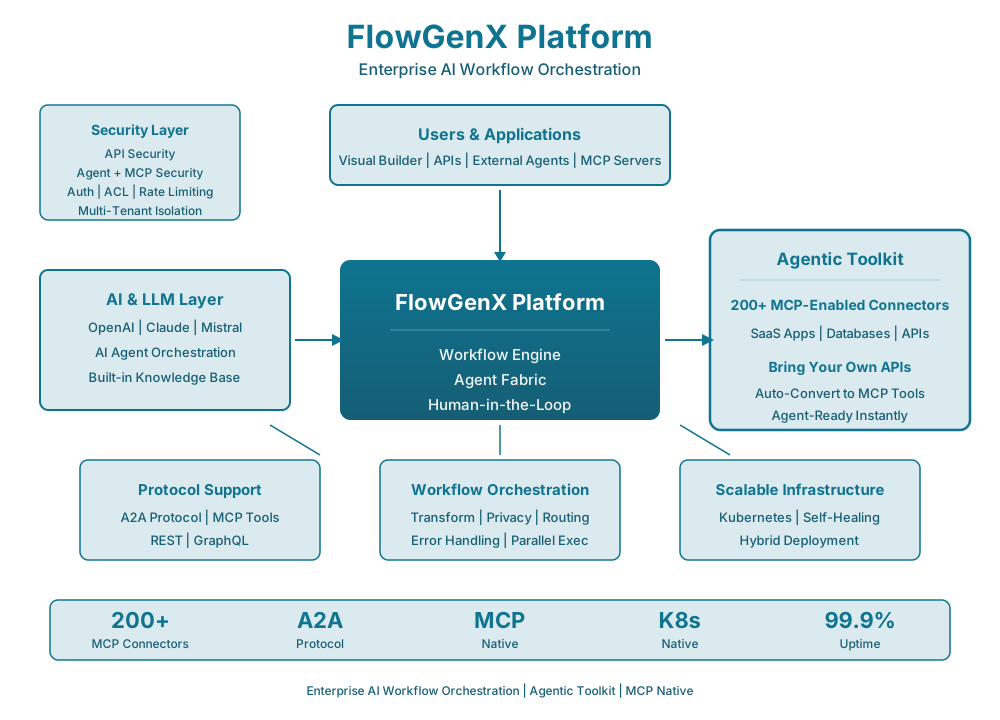
The FlowGenX AI Solution
Traditional integration suites demand brittle rules and endless scripting. FlowGenX AI introduces agentic automation so builders can design outcomes and let AI handle the details.
- Natural Language Processing – Define workflows and agents conversationally instead of coding bespoke logic or complex diagrams.
- Contextual Understanding – Agents interpret business intent, historical state, and policies to choose the right action.
- Autonomous Decision-Making – Reasoning engines apply rules, guardrails, and learned patterns to run workflows end to end.
- Self-Healing Workflows – Automations detect upstream changes, retry or compensate, and escalate to humans when needed.
Why FlowGenX AI?
Challenges with Legacy Integration
- Rigid configurations that require manual code for every edge case.
- Limited flexibility when business rules or upstream schemas change.
- High maintenance burden across connectors, schedules, and retries.
- No intelligence to interpret context, handle exceptions, or learn from outcomes.
FlowGenX AI Advantage
- Publish guardrailed AgentCards that any internal or partner agent can invoke.
- Listen to SaaS events (Zendesk, HubSpot, Salesforce, etc.) and trigger workflows instantly.
- Blend automation and human oversight with built-in HITL approvals and callbacks.
- Deploy on FlowGenX Cloud or your own Kubernetes footprint without losing governance.
Core Capabilities
1. Intelligent Workflow Automation
Agents orchestrate complex, multi-step workflows across SaaS APIs, databases, queues, and on-prem services.
Example use cases
- Automated onboarding across CRM, billing, communications, and compliance systems.
- Intelligent document processing and enrichment with downstream approvals.
- Cross-system data synchronization with conflict detection and resolution.
- Automated compliance validation, evidence capture, and reporting.
2. Universal System Integration
- 100+ built-in integrations plus full MCP hosting/server support so agents can consume internal or partner APIs as Model Context Protocol resources.
- One-click API onboarding: connect any REST/GraphQL endpoint, expose it as an MCP action, and immediately add it to agent toolbelts.
- SQL/NoSQL databases with credential brokering, pooling, and query templates.
- File/object stores (S3, Azure Blob, Google Drive, FTP) for batch handoffs and archival workflows.
- Message queues and event buses (Kafka, RabbitMQ, Redis Streams, webhooks) for real-time triggers.
- Custom adapters for proprietary protocols, on-prem workloads, or regulated environments.
3. Generative AI at the Core
- Large Language Models for natural-language understanding, summarization, and planning.
- Reasoning engines blend policies, memories, and guardrails to pick the next step.
- Pattern recognition learns from historical outcomes for predictive remediation.
- Natural-language interfaces let builders test, debug, and explain workflows conversationally.
4. Enterprise-Grade Security
- End-to-end encryption for data in transit and at rest.
- Role- and policy-based access controls with tenant isolation and least privilege.
- Full audit logging and lineage capture for every workflow, callback, and agent message.
- Compliance alignment with SOC 2, GDPR, HIPAA, and other frameworks.
- Secure credential vault with rotation, scoping, and delegated access.
Featured Highlights
Agentic Workflow Development
Design multi-step, parallel, and long-running workflows that blend AI agents and human approvals.
200+ Integrations
Connect CRM, ERP, databases, SaaS, and on-prem systems with pre-built connectors and extensible adapters.
Agent Builder
Create ReAct, supervisor, and multi-agent systems with guardrails, memory policies, and tool access.
API → Agentic Actions
Turn any REST API into an AI-actionable capability with automatic schema detection and semantic mapping.
How It Works
Multi-Layer Architecture
- Agent Layer – Autonomous AI agents execute workflows and interact with systems.
- Intelligence Layer – LLMs, reasoning engines, memory, and policy evaluators drive decisions.
- Integration Layer – Connectors, event listeners, and data pipelines interface with external systems.
- Orchestration Layer – Workflow engine, schedulers, and HITL services coordinate execution.
- Observability Layer – Metrics, logs, traces, and analytics expose every action and dependency.
Agent Lifecycle
- Define – Capture the agent's mission, guardrails, and success metrics.
- Train & Configure – Provide prompts, tools, integration mappings, and policy scopes.
- Deploy – Promote to sandbox, staging, or production via the Agent/API Gateway.
- Execute – Agents run autonomously, invoking workflows, APIs, and HITL checkpoints.
- Monitor – Track lineage, SLAs, user feedback, and anomalies.
- Optimize – Iterate on prompts, costs, and logic using telemetry and experiments.
Key Differentiators
True Autonomy
Agents reason, adapt, and self-heal instead of simply following static scripts.
Low-Code + Natural Language
Builders use templates, visual canvases, or prompts to deliver enterprise automations.
Scalable Architecture
Scale from departmental pilots to global automation programs within one mesh.
Continuous Learning
Agents learn from historical performance, user feedback, and policy evaluations.
Who Uses FlowGenX AI?
By Role
- Developers extend agents and integrations using SDKs and control-plane APIs.
- Business analysts design workflows with low-code tooling and natural-language inputs.
- Operations teams automate repetitive processes while monitoring execution health.
- IT leaders enforce governance, modernize integration estates, and manage costs.
By Industry
- E-commerce – Order processing, inventory sync, customer support copilots.
- Healthcare – Scheduling, claims intake, document intelligence, patient outreach.
- Finance – Transaction monitoring, compliance workflows, fraud triage.
- Manufacturing – Supply-chain orchestration, quality control, predictive maintenance.
Getting Value Fast
Quick Wins
- Email + Ticket Automation – Classify, route, and draft responses with HITL approvals.
- Document Processing – Extract, validate, and upload structured data to ERP/CRM systems.
- Report Generation – Aggregate multi-system data and publish tailored insights.
- Customer Notifications – Trigger personalized updates from event streams.
Strategic Transformation
- Process Orchestration – Coordinate cross-department workflows with SLAs and compliance checkpoints.
- Intelligent Decision Systems – Automate approvals and triage using AI-driven policies.
- Self-Service Portals – Deliver conversational experiences for employees and customers.
- Predictive Operations – Use telemetry to anticipate issues and launch preventative actions.
The Future of Integration
FlowGenX AI turns integration into a conversational, adaptive fabric. Systems collaborate intelligently, workflows update themselves as business needs evolve, employees focus on strategy while AI handles execution, and every action remains auditable and governed.