Platform Overview
A comprehensive overview of FlowGenX AI's platform architecture, components, and how they work together to deliver intelligent automation.
What is FlowGenX AI?
FlowGenX AI is a unified Agentic Integration Platform that blends no-code workflow automation with governed agent development. Built for modern enterprises, it orchestrates deterministic and AI-driven flows across 200+ integrations, secures every action through the Agent/API Gateway and Istio mesh, and layers LangGraph execution with Agent Fabric (A2A/MCP/WebSocket), HITL controls, and RAG-ready knowledge bases so organizations can automate safely, observe every step, and keep people in the loop whenever needed.
Platform Overview
Unlike rigid integration suites that depend on predefined rules, FlowGenX AI leverages generative AI to create agents that can:
- Understand Context – Comprehend natural-language instructions, historical data, and business constraints.
- Make Decisions – Evaluate situations and autonomously choose the correct action based on rules, memories, and AI reasoning.
- Adapt and Learn – Improve performance through feedback, outcomes, and monitored signals.
- Execute Complex Tasks – Coordinate multi-step workflows that span SaaS applications, on-prem systems, and event streams.
Why FlowGenX AI?
FlowGenX closes the gap between traditional integration, workflow orchestration, and the new era of agentic automation.
The Challenge with Traditional Integration
- Rigid Configurations – Every edge case requires manual programming or brittle branching.
- Limited Flexibility – Changing business logic means refactoring diagrams and connectors by hand.
- High Maintenance – Teams must constantly update integrations as upstream APIs evolve.
- No Intelligence – Legacy tooling cannot interpret context, handle exceptions gracefully, or reason about next steps.
FlowGenX AI Solution: Agentic Automation
- Natural Language Processing – Create, refine, and test workflows using conversational prompts instead of bespoke DSLs.
- Contextual Understanding – Agents understand intent, semantics, and business policies, not just payload formats.
- Autonomous Decision-Making – AI agents apply business rules and learned patterns to choose the next action automatically.
- Self-Healing Workflows – Automations detect upstream changes, retry intelligently, invoke compensating logic, and escalate to humans when governance demands it.
Core Capabilities
- Workflow Automation – Build event-driven or batch automations with retry/compensation logic, scoped state, conditional routing, and lineage tracking.
- Workflow Orchestration – Coordinate long-running processes across services with HITL checkpoints, scheduling, async callbacks, and tenant-aware SLA controls.
- Agentic Workflow Development – Compose intelligent flows that mix deterministic steps with agent decisions using low-code/no-code canvases, API definitions, or natural-language prompts.
- Agent Development & Testing – Publish ReAct, supervisor, or multi-agent systems; manage AgentCards; and validate behaviors in a no-code studio with simulators, A/B testing, and policy enforcement.
- AI Data Processing & Privacy – Apply natural-language enrichment, semantic transformation, redaction, and privacy-safe grounding with masking, budgets, and lineage visibility.
- Agent Fabric – Registry, task broker, and A2A/MCP endpoints (plus WebSocket streams) translate agent intent into FlowGenX workflows while enforcing scoped policies and costs.
- Human-in-the-Loop – Task routing, approvals, SLAs, and escalation policies keep experts in the loop wherever governance requires it.
- Async & Eventing – Reliable webhooks, callback tracking, streaming task updates, Redis/Kafka-backed queues, and SaaS listeners (Zendesk, HubSpot, Salesforce, and more) keep workflows responsive.
- Scheduling – Cron, interval, and one-time scheduling with timezone awareness, catch-up controls, and triggered follow-up actions.
- Tenancy & Control – Per-tenant quotas, scoped credentials, agent-level cost centers, and governance policies enforced from the gateway through execution.
1. Intelligent Workflow Automation
FlowGenX agents orchestrate complex, multi-step workflows spanning SaaS APIs, databases, queues, and on-prem services. Whether processing customer orders, managing inventory, triaging support tickets, or handling compliance, agents work autonomously end to end.
Example use cases
- Automated customer onboarding across CRM, billing, communications, and compliance platforms.
- Intelligent document processing, classification, and data extraction with downstream enrichment.
- Cross-system data synchronization with conflict detection and resolution logic.
- Automated compliance validation, evidence collection, and report generation.
2. Universal System Integration
Connect virtually any system via FlowGenX's integration fabric:
- REST and GraphQL APIs for modern services.
- Direct SQL/NoSQL database connections with credential brokering.
- File systems and object storage (S3, Azure Blob, Google Drive, FTP, etc.).
- Message queues and event buses (Kafka, RabbitMQ, Redis Streams, and more).
- Custom protocols and adapters for proprietary systems.
3. Generative AI at the Core
- Large Language Models (LLMs) power natural-language understanding, summarization, and action planning.
- Reasoning engines blend policies, memories, and guardrails to pick the next best step.
- Pattern recognition leverages historical outcomes for predictive remediation.
- Natural-language interfaces let builders test, debug, and explain workflows conversationally.
4. Enterprise-Grade Security
- End-to-end encryption for data in transit and at rest.
- Role- and policy-based access controls with tenant isolation and least-privilege enforcement.
- Full audit logging and lineage capture for every workflow, callback, and agent message.
- Compliance alignment with SOC 2, GDPR, HIPAA, and other frameworks.
- Secure credential management with encryption, rotation, and scoped usage policies.
Featured: Agentic Workflow Development
Design sophisticated multi-step workflows with parallel execution, sagas, long-running processes, and hybrid agent/human patterns. FlowGenX can subscribe to any application or data event (Zendesk, HubSpot, Salesforce, custom systems) and route those signals into intelligence-infused workflows.
Featured: Dozens of Agentic Building Blocks
Triggers, actions, logic steps, transformation nodes, and AI components let builders compose automations from a drag-and-drop canvas or API definitions—no custom code required, yet every block remains observable and policy-aware.
Featured: 200+ Integrations
Leverage pre-built connectors for CRM, ERP, databases, cloud services, productivity suites, and legacy systems to achieve any-to-any connectivity in minutes.
Featured: Building Agents
Create ReAct-style, supervisor, or multi-agent systems; configure LLM models, memory strategies, prompts, and tool access; and govern each agent via AgentCards, rate limits, and approval flows.
Featured: Enabling APIs into Agentic Actions
Convert any REST API into an agent-ready action with automatic schema detection, semantic parameter mapping, and reusable templates that stay synchronized as services evolve.
Featured: Knowledge Base
Deploy RAG-powered knowledge bases with vector search, intelligent chunking, and semantic retrieval so agents respond using approved enterprise content and policy-compliant data.
How It Works
Agent Architecture
FlowGenX AI uses a multi-layer architecture:
- Agent Layer – Autonomous AI agents that execute workflows.
- Intelligence Layer – Generative AI models and reasoning engines that power decision-making.
- Integration Layer – Connectors and adapters for external systems and data sources.
- Orchestration Layer – Workflow management, scheduling, and lifecycle coordination.
- Observability Layer – Monitoring, logging, analytics, and alerting for every invocation.
The Agent Lifecycle
- Define – Describe the agent's purpose, scope, and guardrails.
- Train & Configure – Provide examples, prompts, model settings, and integration mappings.
- Deploy – Activate the agent within sandbox, staging, or production environments.
- Execute – Agents run autonomously, invoking systems, workflows, or HITL checkpoints.
- Monitor – Track performance, lineage, anomalies, and user feedback.
- Optimize – Fine-tune prompts, policies, or integrations based on outcomes.
Architecture at a Glance
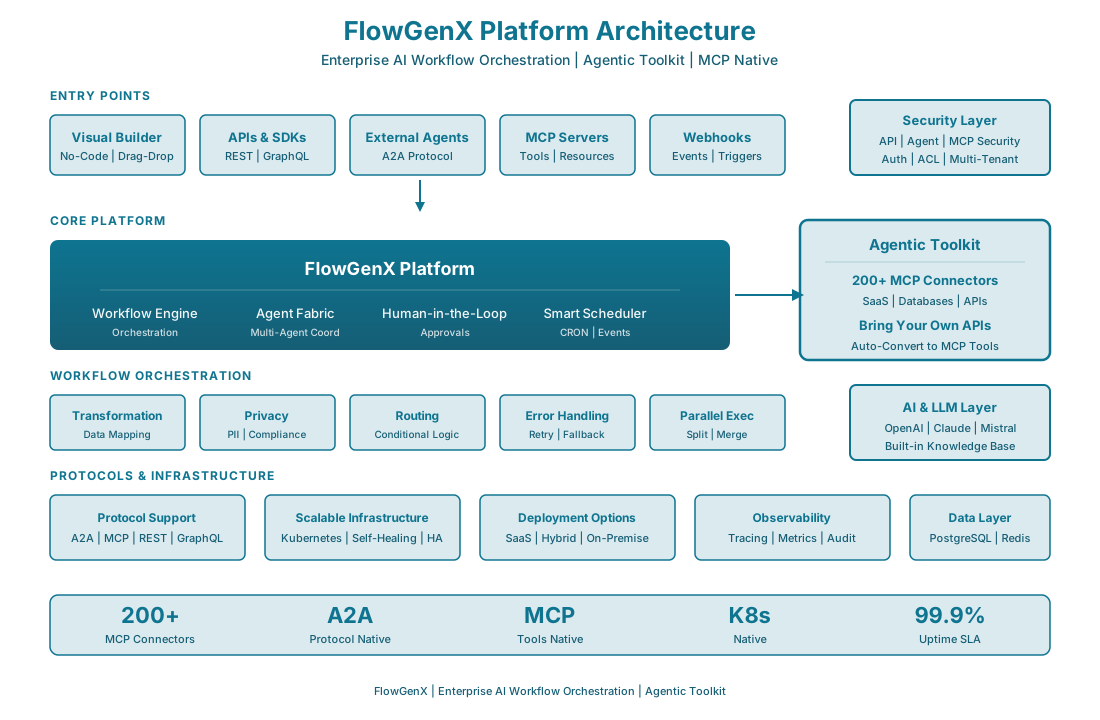
- Experience Layer – The Agent/API Gateway authenticates traffic, applies rate limiting, evaluates policies, and routes requests into the Istio mesh.
- Service Mesh – Istio provides mTLS, traffic steering, and resiliency for the API Router, Control API, Workflow Engine, HITL Engine, and worker fleets.
- Agent & Workflow Services
- API Router exposes REST/GraphQL endpoints, fabric proxies, webhooks, and streaming callbacks.
- Agent Fabric hosts
/fabric/*,/a2a/*, and/mcp/*for agent registration, brokering, and interoperability. - Workflow Engine executes LangGraph flows with Redis/PostgreSQL-backed state, while async workers and schedulers drive background execution and callbacks.
- Data & Observability – Dual PostgreSQL clusters separate configuration from runtime execution, Redis clusters cache state/queues, and Prometheus/Grafana/Loki/Tempo provide metrics, logs, traces, and alerting.
Agent Fabric & Integration
- Agent Registry & Broker – Publish capabilities as AgentCards, approve them through governance workflows, and let the broker route requests to the most qualified workflow or external agent.
- Interoperability – Built-in A2A server/client modes, MCP endpoints, and WebSocket streaming let other LLM agents, Flex Gateways, or partner platforms invoke FlowGenX assets and receive state changes in real time.
- Policy-Aware Execution – Evaluate trust, cost, compliance, and rate policies before tasks run by combining Agent/API Gateway plugins, Istio guards, and fabric-level scopes.
Key Differentiators
- True Autonomy – Agents reason, adapt, and make decisions beyond predefined steps.
- Low-Code/No-Code – Build powerful workflows and agents using natural language, templates, and visual tools.
- Scalable Architecture – Handle everything from simple departmental automations to enterprise-wide agent programs.
- Continuous Learning – Agents improve over time via telemetry, human signals, and historical outcomes.
Platform Highlights
- 200+ Integrations – Connect SaaS, data platforms, and on-prem systems with any-to-any connectivity.
- 99.9% Uptime SLA – Resilient architecture with auto-scaling workers, circuit breakers, and health-aware routing.
- Hybrid Deployment – Run FlowGenX in our cloud, your VPC, private cloud, or on-premises with the same management plane.
- Agent Gateway – Central routing, monitoring, scaling, and budgeting for every agent and workflow invocation.
Security & Operational Guardrails
- OAuth2/JWT enforcement at the edge, mTLS inside the mesh, and per-tenant secrets management protect every hop.
- Rate limiting, WAF protections, and circuit breakers shield downstream systems from abusive traffic.
- Detailed audit trails capture every workflow execution, agent call, callback, and human decision for audit readiness.
- Observability dashboards surface throughput, agent success rates, HITL backlog, and infrastructure health in real time.
Deployment Footprint & Use Cases
FlowGenX ships as containerized services for Kubernetes (preferred) or Docker Swarm, with Helm/Terraform blueprints covering single-region, multi-region, and air-gapped environments. Leading use cases include:
- Regulated onboarding flows that demand human review with full lineage.
- Agent brokering for analytics, customer support, or RAG copilots operating under shared governance.
- Long-running, callback-driven processes such as claims, underwriting, supply-chain, or field-service automation with strict SLAs.
Who Uses FlowGenX AI?
By Role
- Developers – Extend agents and build custom integrations with comprehensive APIs.
- Business Analysts – Create workflows with low-code tooling and natural-language instructions.
- Operations Teams – Automate repetitive processes and monitor execution health.
- IT Leaders – Reduce technical debt, enforce governance, and modernize integration infrastructure.
By Industry
- E-commerce – Order processing, inventory management, customer service automation.
- Healthcare – Patient data management, appointment scheduling, claims processing.
- Finance – Transaction processing, compliance monitoring, fraud detection.
- Manufacturing – Supply chain optimization, quality control, predictive maintenance.
Getting Value from FlowGenX AI
Quick Wins
- Email processing – Categorize, route, and respond automatically.
- Data entry – Extract information from documents and update downstream systems.
- Report generation – Aggregate multi-system data and publish tailored reports.
- Customer notifications – Trigger personalized updates based on real-time events.
Strategic Transformation
- Process orchestration – Coordinate complex workflows across departments.
- Intelligent decision systems – Automate approvals and triage with AI-driven logic.
- Self-service portals – Deliver conversational interfaces for employees or customers.
- Predictive operations – Anticipate issues and launch preventative actions.
More Features
- Data Discovery & Analytics – Profile schemas, explore data sources, and surface insights with built-in dashboards.
- Hybrid Deployment – Deploy runtimes in your environment—on-premises, private cloud, or sovereign regions.
- Workflow Canvas – Visual drag-and-drop editor for designing automations and agentic flows.
- Event Streams – Real-time triggers from webhooks, databases, queues, and SaaS systems such as Zendesk, HubSpot, Salesforce, and more.
- Managed Auth – Enterprise authentication with OAuth, API keys, and SSO.
- Agent Gateway – Centralized governance, observability, and scaling for every agent and workflow.
- Human Approval – Insert human oversight and approval gates wherever policy dictates.
- Traceability – Full execution traces for debugging, compliance, and post-incident review.
Quick Start Guide
- Request Access – Sign up for FlowGenX AI platform access.
- Set Up Environment – Configure your development workspace, credentials, and connectivity.
- Explore Node Library – Browse pre-built workflow nodes, agent components, and integrations.
- Connect Systems – Integrate with 200+ enterprise applications and data sources to launch your first agentic workflow.
Explore the Documentation
- Node Library – Pre-built nodes for every integration and automation use case.
- Agentic Workflows – Patterns for enterprise orchestration with HITL and AI agents.
- Integrations – Catalog of 200+ connectors for SaaS, data, and on-prem systems.
- Knowledge Base – RAG-powered knowledge retrieval and content management guidance.
Need Help?
- Visit the FlowGenX AI website for the latest product updates.
- Contact Support for troubleshooting, onboarding, or best-practice guidance.
- Request a demo to see the Agentic Integration Platform in action.
The Future of Integration
FlowGenX AI represents a fundamental shift in how businesses approach automation and integration. Systems communicate intelligently instead of merely exchanging data, workflows adapt automatically to changing business needs, employees focus on strategy while AI handles execution, and integration becomes conversational rather than purely technical.
What is FlowGenX AI? FlowGenX AI is the Agentic Integration Platform that leverages generative AI to automate workflows and integrate systems intelligently, combining natural-language design, contextual understanding, autonomous decision-making, and self-healing workflows with enterprise-grade governance, security, and observability.